Root canal treatment: does it hurt, and when is it necessary?
Introduction
“We’ll need to do a root canal on this tooth.” For many patients, that sentence is frightening. Root canal treatment has a reputation for being long and painful, a reputation that often comes from stories of another era.
Today, root canal treatment is a routine procedure performed under local anaesthesia. Its goal is simple: to save a tooth that would otherwise have to be extracted.
In this article, we explain what a root canal is, when it becomes necessary, what you will actually feel, and what happens afterwards.
What is a root canal treatment?
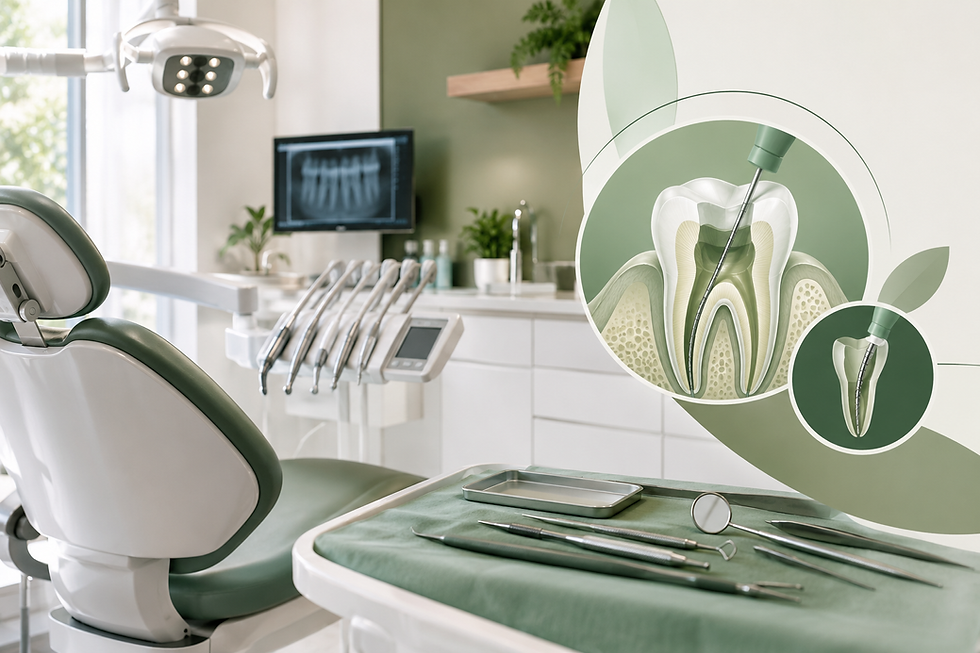
At the centre of every tooth is the pulp, a living tissue made of nerves and blood vessels. It extends through canals down to the tips of the roots. When the pulp is too badly damaged (irreversible inflammation, infection, necrosis), it can no longer heal on its own.
Root canal (endodontic) treatment means removing this pulp, cleaning and disinfecting the canals, and then sealing them. The tooth is preserved: it stays anchored in the bone and keeps working for chewing.
When is a root canal necessary?
The most common causes are deep decay that has reached the pulp, trauma to the tooth, a crack, or a tooth that has had repeated treatment.
Note: an infection can also develop without any pain. It is then found at a check-up or on an X-ray, which is another reason to keep up regular visits.
Does it hurt?
How does the treatment work?
Afterwards: what happens to a root-canal-treated tooth?
The tooth no longer feels hot or cold, but it stays in place and works normally. It does become more fragile, especially if a lot of tooth structure was already missing. That is why a crown or onlay is often recommended, particularly for molars and premolars.
It can still get decay, so brushing, interdental cleaning and check-ups remain essential.
What if I wait?
Why not just extract it?
That is possible, but an extracted tooth usually needs replacing (implant, bridge, denture) to stop the neighbouring teeth from shifting and the bone from shrinking. When it can be done, keeping your natural tooth is usually the best option.
Conclusion
Root canal treatment is not the ordeal many people imagine. Done under anaesthesia, it relieves pain rather than causing it, and it saves a tooth that would otherwise be lost.
Lingering pain, a swollen gum, a tooth changing colour? Don’t wait. Our team will take the time to examine you and clearly explain the options for your situation.


Comments